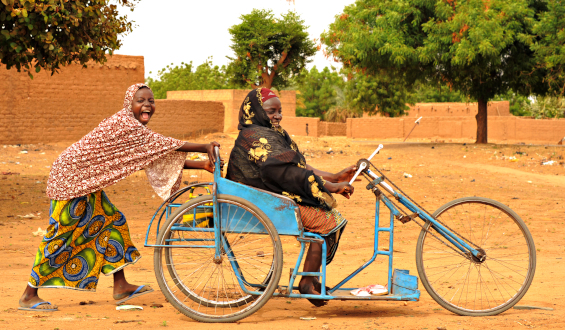
I’ve spent close to 10 years in the community development field and as time continues to go on I become more and more aware of the burdens that women in poverty face. Add to these women with disabilities living in poverty and those of ethnic or religious minorities and the equation they are faced with represents what is referred to as a double and sometimes even triple marginalisation burden in their pursuit of an improved quality of life.
When considering the stigma and discrimination associated with disability on its own, it’s easy to then draw on how being a woman with disability within developing societies would represent further exclusion. Recent studies have found that women with disabilities are twice as likely to experience gender based, domestic and sexual violence than women without disabilities. In many circumstances those with intellectual disabilities or who suffer from mental illnesses are stripped of the basic decision making capacities for their own lives and degraded to the point of forced sterilisation and/or institutionalisation against their will.
In the Indian context, countless experiences have been documented where husbands who are unhappy with their wives forcibly institutionalise them in order to then re-marry. Once within psychiatric institutions these women are stripped of all their rights, heavily medicated and undergo forced electro shock therapy. Not to mention the undocumented cases of these women facing ongoing physical and sexual violence as they are left to wallow within these institutions and robbed of all decision-making capacity of their own mental and reproductive health.
Within my work I also often find cases where women with disabilities are treated like second-class citizens within their own homes and societies. They are essentially stripped of every aspect and opportunity towards voice, leadership and decision-making capacity. This occurs within decisions regarding their own lives as well as, being crowded out of the process for participation within community mobilisation resulting in development. This is most likely due to ill-conceived presuppositions of their ‘capacity’ to contribute or in the community’s beliefs, their lack thereof.
The lesson to remember in all of this is that as the fight for equality and women’s rights goes on, let’s try not to forget that women facing discrimination worldwide are not a homogenous group. Women with disabilities face all the discrimination involved with their sex and preconceived limiting gender roles, as well as, the stigma, exclusion and discrimination that exists towards persons with disabilities. Let’s ensure that the double and triple burden that plays out in the lives of women with disabilities does not go unchecked or unnoticed as we continue the fight for equality.
Sx
*Image Courtesy of CBM International
 I blog for Change.