
It was my first visit to Bihar which is located in the north-eastern part of India and borders the neighbouring countries of both Nepal and Bangladesh. The state in the past has been infamous for slow rates of progress out of poverty and unfortunately lags behind the rest of India when it comes to economic development, health and educational outcomes.
My visit itself however coincided with the end of the monsoonal rains and therefore the countryside I was travelling through was laden with lush green paddy everywhere I looked. Interestingly, 80% of the state’s workforce are engaged in agricultural activities however the majority of these are landless farmers; basically meaning they do not own the land they tend and therefore are engaged as daily wage labourers who benefit little from sales of produce. Knowing this, I was keen to understand how this dynamic worked and interested to find out how people with disabilities fitted into this already complex equation.
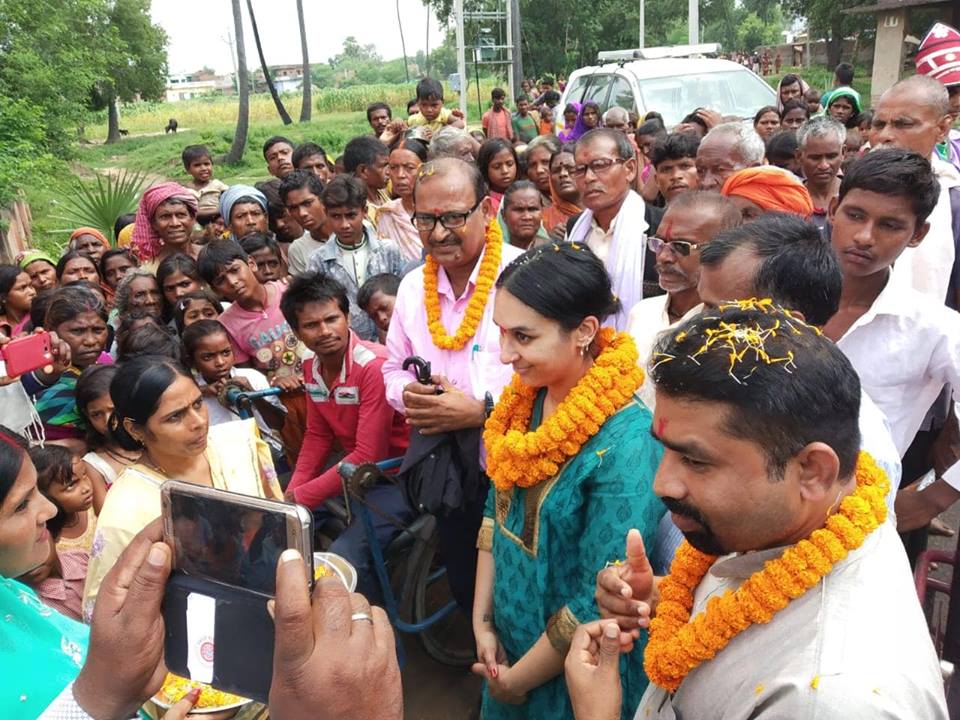
As our vehicle wound through the streets it eventually came to a stop at the front of a community centre. Looking up my vision line was engulfed with a sea of orange as the community members waited to greet me with beautiful garlands of marigold, their traditional welcome to guests visiting their village. I was immediately aware as we sat down for a discussion with the community members that it was the women who sat in the front and spoke up most confidently.
They told stories of how the local Partner in the area had gone on a journey with them to facilitate a better understanding about their own rights. They spoke of how they had been assisted to mobilise and organise themselves in groups in order to lobby for change and demand their rights as equal citizens.
CBM’s approach in communities is to assist with the formation of local community groups such as Self Help Groups (SHGs) and Disabled Peoples Organisations (DPOs). Members of these groups work together to address their needs and promote change through collective action. This works on the strengths based model which purports that all people have the inherent capacity to contribute towards bettering their own lives. The approach thus buys in to the concept that an external NGO or charity’s role is simply to support people to identify the skills they have, mobilise them within community support mechanisms and facilitate links with vocational training centres, banks and also to members of their local government.
For the people of this village, with the support of the local Partner, that then meant as a group they were able to go directly to their local government officials and ensure that all people with disabilities in their communities were provided with a disability certificate. This certification then means that they can access pensions and schemes to assist with meeting their health and rehabilitation needs.
A leader of the local DPO was present during one of the community meetings which I attended during this visit. He spoke openly and with confidence of how the project had worked to empower him and others on many different levels. He spoke of first having his and his community’s awareness raised on the rights they possess as equal citizens. To then, the facilitation of linkages towards vocational training and opportunities for income generation that enable people with disabilities towards economic empowerment. He also identified how the Partner had worked to form strong, inclusive collective groups that aim to hold duty bearers, such as local government accountable for ensuring equality and development for all. This includes providing guidance around how to spend budgetary allocations for spend on disability and inclusion.
When I asked why it was so important to form and build the capacity of such groups he answered with clarity by stating “so that we can access opportunities which are linked with our human rights and try to raise ourselves out of poverty just like everyone else”.
Sx
 I blog for Change.