I took part in a Cultural Safety and Respect workshop last week which was part of my company’s conscious effort to ensure a sense of cultural awareness in all that it does. The theme of this particular training focused on engaging in culturally respectful work with Aboriginal Australians including identifying and understanding institutional racism and how to respond to this.
It was an interesting experience for me and a first for most of on the day. The idea of spending an entire day calling out unconscious biases and acknowledging institutional racism based on personal experience was poignant in a way that I was achingly aware of. As I looked down at the agenda, I noticed that the second half of the day was almost completely dedicated to the theme of ‘whiteness’ and what that meant, including how this notion was connected to neo-colonialist ideas of supremacy based on skin colour and race.
At the time I remember thinking, well obviously this doesn’t occur to me because whiteness is not applicable with my personal existence. I am person of colour and a 1st generation migrant so I have been on the receiving end of this sense of entitlement and power more than once in my lifetime. So I sat back feeling pretty good about my woke self. In my mind, I reflected on all of the times that my parents had faced discrimination based on race as they went about their daily lives. How people had spoken down to them and belittled their voice when it came to affairs of this country because they sat outside the image of what ‘an Australian’ should like. I thought about all the times I wondered why I saw no one that looked like me on TV or in magazines, and shuddered at the times I, and those who I love, had been racially vilified on the street. I felt pretty comfortable at that moment that this workshop was not meant for me.
But as the workshop went on we heard about first hand experiences from Sharon Gollan*, one of the facilitators of the event. She spoke openly and honestly about what it has been like as an Aboriginal Australian trying to operate in a culture that parades and values whiteness and dismisses and shames everyone who sits outside of it. She reflected on what it was like to grow up in a country that shunned, detained and forcibly extracted people that looked like her. At one point she even explained the level of degradation involved with being forced to tick a box which identifies her as being Aboriginal Australian and then having to come up with documentation to prove this status. She spoke of the stolen generation, and of the inherent and unyielding racism that is thrown her way every single day. Including the misconceptions of what Aboriginal people are depicted to be and the negative connotations of what this means in modern day society. She reflected on the imminent and real threat of being on edge all the time for the fear of being racially vilified yet again. We were reminded of the structural discrimination that has been in place within our legal system targeting her people for the better part of the decade and how this legacy continues within unconscious biases today.
Throughout all of this, I sat there in awe. At the beginning of the day I had assured myself that the toxic level of ‘whiteness’ being spoken of did not include me. But as the day went on I started to understand that I fell into a parallel of whiteness, being within the dominant culture. Yes I am not apart of whiteness, I mean obviously I am brown. But even being a citizen of this country means that I am in some element apart of its history and therefore terrifyingly, that I am complicit with the institutional basis of the racism and oppression associated with the experience of Aboriginal Australians.
I realised quite quickly that I enjoy a relative privilege within my life. Yes, I am a person of colour but I am educated, I was lucky enough to have opportunities which meant that I came from a stable household, went to university and came out with 2 degrees. While my background is not from the dominant culture there has not been decades and close to centuries of threats to that identity in my experience. I still enjoy a certain sense of oneness when I return to my second homeland and I am subjected to hurtful misconceptions of what it means to be Sri Lankan there. When I look at the intrinsic nature of institutional racism and the struggles myself and people who look like me have faced, it feels both similar but also entirely different to those which Aboriginal Australians have come up against.
It brings up the element of power dynamics and the intersectionality which exists that means that not all discrimination is felt the same way; and that the diversity that exists within people of colour is stark. Adding into the mix the oppression of indigenous people in an already full pot of racism, sexism and everything in between is complicated. It reminded me that I cannot rest on my laurels because of the way I look or because of the racism that I have faced as a 1st generation Sri Lankan Australian. I need to be actively part of ensuring that I am an ally that builds on a shared perspective as people of colour to work towards creating respectful partnerships with Aboriginal Australians within a dominant culture which says we are all not apart of it.
Sx
*Sharon Gollan is a direct descendent of the Ngarrindjeri nation of South Australia, with family and cultural connections to many communities within and beyond South Australia. She is well known and highly regarded for her work as a leader and facilitator of Cultural Respect and Safety training that focus on how to create respectful partnerships between Aboriginal and non-Aboriginal Australians.
https://www.beyond-kathleenstacey.com.au/company-and-people/people-and-relationships/
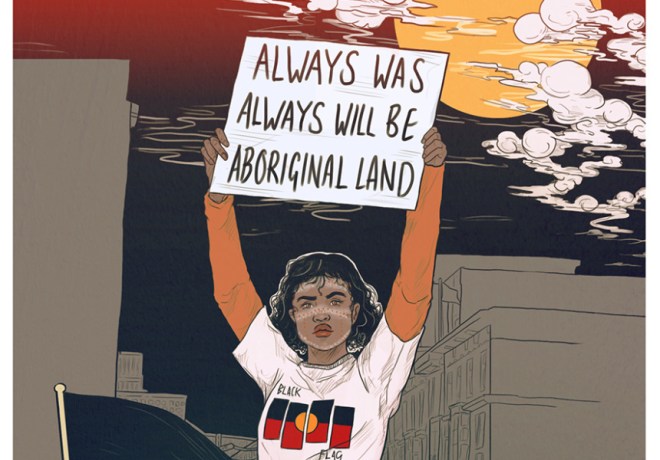
*Image courtesy of: Charlotte Allingham – https://www.instagram.com/coffinbirth/?hl=en
 I blog for Change.