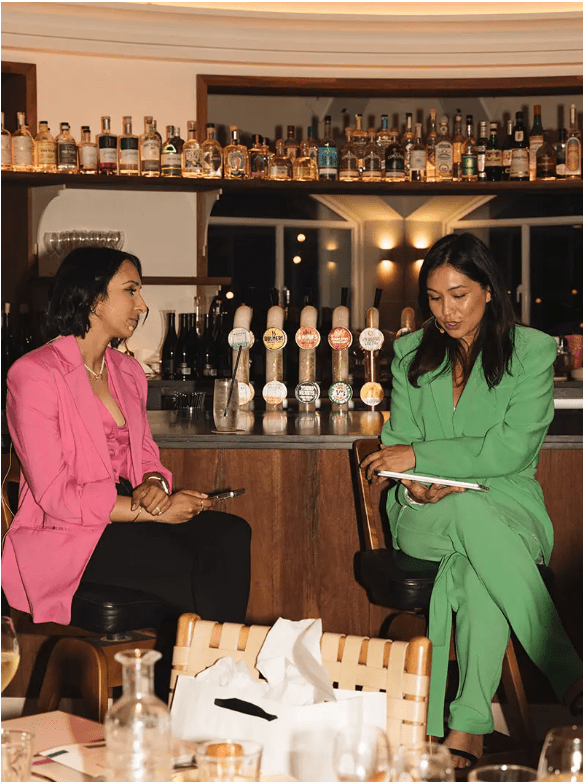
I was recently invited to speak at a very special InStyle Supper Club event which focused on CARE Australia’s HerCircle event hosted by Instyle’s Editor in Chief, Justine Cullen. Below are some excerpts from my speaking time:
JC: CARE’s Her Circle campaign is inspired by the multiplier effect, which states that when one woman escapes poverty, she brings four others in her circle with her. How does this work and do you have examples of the multiplier in action?
SG: We know that when a woman escapes poverty she brings 4 others in her circle with her; that’s a powerful multiplier.In her home, workplace and community she is the change maker, if we can enable her with the skills she needs to lift herself out of poverty she will take others in her family and her community with her.
Research shows us that a woman has the tools and support she needs to empower herself: she is less likely to die in childbirth, she is more likely to have healthy children who attend school, she is more likely to earn an income; which she will more than likely reinvest back into her household and community. When her voice is listened to, she’ll speak not only for herself but for those around her.
Real time examples from the Philippines, indicate that when women earned a greater share of income, their household’s intake of calories and protein increased significantly.
We have to support women to claim their fair share of resources, opportunities and decision making power to create lasting change.
JC: What’s interesting is that while we live in a patriarchy, the multiplier effect reveals that women actually hold this incredible power in their communities. While the onus shouldn’t land solely on women to make change, should we be heartened by the power and potential we as women hold to uplift others around us?
SG: Yes, absolutely. Women in great numbers are incredibly powerful. Research conducted and compiled over four decades found the most powerful tool for reducing violence against women in communities in which we work was women’s groups. The research found that mobilisation of women’s organisations and movements is more important in tackling VAW and girls than a nation’s income, progressive political parties or the representation of women in politics.
I’ve seen examples of this happen in practice. On a visit to South Asia I encountered a very powerful women’s organisation who were well known in their communities. The group focused on preventing gender based violence by raising awareness, engaging men and boys and jointly supporting women to report instances of domestic and sexual violence to authorities. What was evident was that women feel less vulnerable in groups. Surrounding communities told stories of large groups of women going together to the police station to report an offence.
But noting that there’s still more work to be done in order to achieve gender justice.
Structural inequalities still exist, such as a lack of entry into labour markets, lack of access to healthcare, high rates of gender based violence inhibits women’s participation, agency and voice
At CARE we approach our work with a multi pronged approach in which we: build individual agency, change relations and transform structures.
Noting also that women are not a homogenous group and we don’t all face discrimination in the same way. Intersecting identities mean that some women will face compounding oppressions. This includes: women of colour, women with disabilities, gender diverse people and those of ethnic minorities. Noting that we can’t achieve gender equality unless we address these intersectionalities
JC: What are some of the biggest issues and inequalities women around the world face right now?
SG: We’ve seen the negative effects of COVID-19 having pushed back decades of gains in gender equality that were made prior to the pandemic.
The Climate crisis is one of the greatest shared challenges we face as a global community.It is predicted that climate change will push an additional 132 million people into poverty by 2030. We know that the climate crisis is not gender neutral. Women and girls experience the greatest impacts of climate driven disasters – they amplify existing gender inequalities and pose unique threats to their livelihoods, health and safety.
In addition to these, economic inequality is still rife. Unpaid labour in which women usually perform the type of work which is informal or unpaid continues without recognition and persistent rates of gender based violence mean progress towards gender equality is slow.
JC: There’s so much hardship on a global scale – war, the climate crisis, an attack on women’s reproductive rights – but what does inequality look like here in Australia?
SG: Sexual harassment and discrimination in the workplace sits at unacceptable levels.
The Gender pay gap sits at 22.8%. Here in Australia, women earn on average 26 and a half thousand dollars less than men a year.
High rates of domestic and intimate partner violence continue to remain strikingly high.
Lastly, a lack of representation of women of colour in leadership positions is worrying. We’ve seen gains in women in leadership positions being occupied by Caucasian women but much less for women in colour. Intersectionality and representation matter!
JC: How can we all get involved with this CARE campaign? How can we bring its ethos into our own circles?
SG: CARE wants to celebrate the achievements of women and gender diverse people not just in Australia but globally, and raise awareness of women as changemakers. HerCircle is providing the opportunity for conversations around gender equality.
Women’s voices need to be heard and we want to get the conversation started on unequal gender roles and women’s roles in leadership. We have to support a woman to empower and uplift herself and her circle.
CARE’s website has a free activity pack which includes facts and info related to our campaign, as well as a conversation starter guide which is an easy enabler to begin these conversations within your own circles.
JC: If you could ensure that everyone here was to take one thing away from tonight, what would it be?
SG: As noted earlier, the onus in fighting for gender justice doesn’t just sit with women. Engaging men and boys and challenging messages on toxic masculinity is integral to the fight. When men rethink long held attitudes and actions pertaining to rigid gender roles, they can accept and celebrate women’s contributions to society and see them as equals and leaders in their own right.
I hope to reinvigorate people’s passion to join the fight to defeat poverty and achieve gender equality globally.
I want people here today to heed these words and feel emboldened to start conversations with your own circles.
Thank you for your time this evening.
For further information on the HerCircle Event please refer to: https://www.care.org.au/her-circle/
For further details on the InStyle Supper Club Event please refer to: https://instyleaustralia.com.au/supper-club-care-australia

 I blog for Change.