A few weeks to mark International Women’s Day I was asked, within my role at CARE Australia, to provide the keynote address for the Climate Council’s ‘Women on the Frontline of Climate Change’ address. Below is an excerpt of that address.
“I’m incredibly honoured to be here with you all to discuss the often overlooked ways that climate change disproportionately affects women.
I currently lead CARE Australia’s program delivery unit that works closely with our Country Offices in the Pacific who are at the forefront of our mission to support women to defeat poverty and achieve climate justice.
While we’ll mostly hear about the Australian context today, I’d like to take you to Vanuatu right now.
As I was preparing for this address I had a script ready to go but the events of last week shifted that. As many of you would know, Vanuatu recently experienced a series of devastating cyclones and earthquakes. What we’ve heard since then is that 80 per cent of the population have been affected by the cyclones which brought floods, landslides and extreme winds. Thousands have been forced from their homes and buildings and crops have been destroyed. In addition to this, the CARE office in Vanuatu was completely destroyed.
This destruction brings home, once again, the devastating effects of the climate crisis and the unique challenges involved with delivering our work in the Pacific. As I open this webinar my thoughts remain with those in Vanuatu who have once again lost everything and with my Ni-Vanuatu colleagues in this difficult time. This rolling cycle of disasters is the stark reality of climate change in Vanuatu and the broader Pacific. It is happening now.
It is predicted climate change will push an additional 132 million people into poverty by 2030. Those living in poverty usually don’t have insurance or broader savings to help rebuild their lives from scratch when disasters strike or to immediately adapt to the ongoing changes to the climate happening around them. And often, those without the financial security required to rebuild their lives after an emergency are women. Women are often tasked with producing food and collecting water, so when resources become scarce, the burden to find more falls upon them. Many women will walk for days to find water or forgo food in order for their families to have enough to eat.
We know that the climate crisis is not gender neutral. Women and girls experience the greatest impacts of climate change-driven disasters – they amplify existing gender inequalities and pose unique threats to their livelihoods, health, and safety. The reasons women are more affected by these disasters are the same reasons women are disadvantaged in so many other ways: they are excluded from accessing resources and making decisions that affect their lives.
For women, the risk of violence, exploitation and abuse is especially heightened during disasters. Girls are also more likely to be forced to drop out of school to help care for family members, where boys are not. Some girls are even forced into early marriage to help their families get through a crisis.
Climate change risks are also more acute for indigenous women and girls, women of colour, older women, women and girls with disabilities, migrant women, and those living in rural, remote, conflict and disaster-prone areas.
CARE, along with our partners, has strived for decades to fight poverty and injustice, but we realise that efforts to promote sustainable development will amount to nothing unless the world tackles climate change – with women at the centre of decision-making. Women like Margaret.
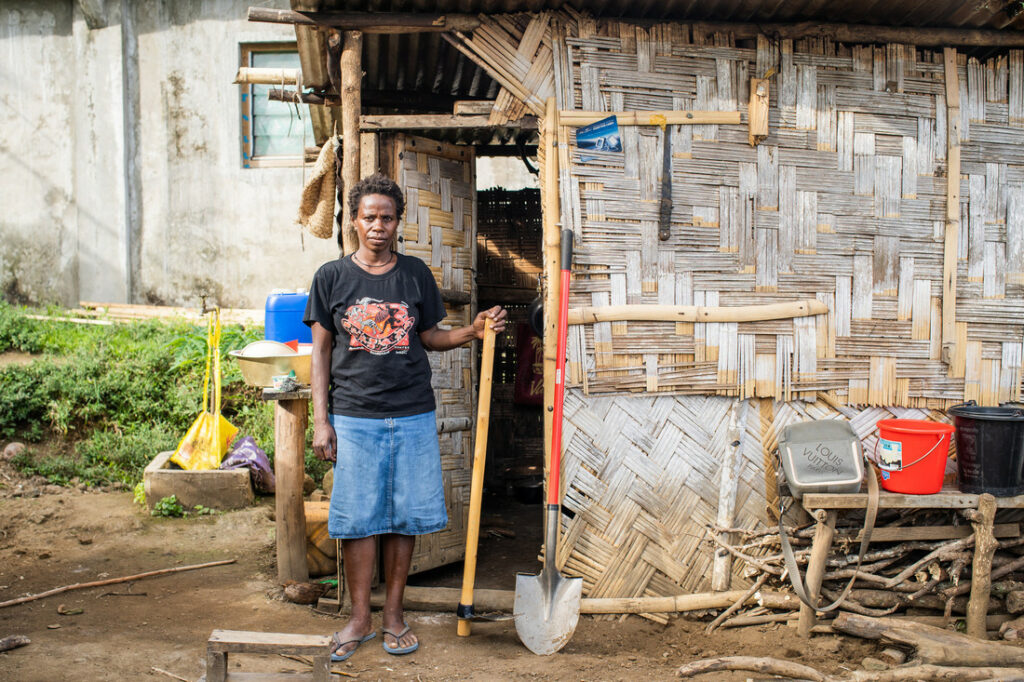
Margaret’s village at the base of Mount Yasur in Vanuatu once looked like something you’d find on a postcard. But Margaret and her family live in the shadow of an active volcano, which has erupted every year since 2015. They are still rebuilding their homes after the devastation of Cyclone Harold in 2020. It has been crisis after crisis for Margaret and her community for the better half of a decade. And the disasters keep on coming.
Just as in Australia, women and girls are impacted in ways that often go overlooked. And too often, they are excluded from decisions about how their communities prepare for and respond to climate disasters. But with the right interventions, they are having their voices heard and leading their communities through climate shocks.
Determined to do what she could to help her community cope with these relentless disasters, Margaret decided to attend CARE’s Community Disaster Committee training.
During training, Margaret and the other community volunteers learned how to build cyclone-proof houses. They ran simulations on what to do when warning alerts are issued by the National Disaster Management Office. They were trained in how to use and maintain emergency equipment. And they learned about the importance of having ALL voices from the community heard.
Women have a human right to participate in the public and political life of their community and country. But it’s a right that’s often denied, especially in emergencies.
When a woman is listened to, she will speak not just for herself, but for others too. And when a woman is given the opportunity to lead in times of emergency, she will prioritise the needs of the most vulnerable – this saves lives.
CARE has piloted tools and approaches which support shifting power and resources directly to women in communities affected by crisis. The result of these pilots is the Women Lead in Emergencies approach; it enables women’s groups to lead public discussions and decision-making efforts in their communities.
Often when you speak to men in the communities in which we work and ask what are community priorities, the emphasis is on economic development and infrastructure. While these are important, when you speak to women the priorities often pivot to other critical issues like accessible health clinics and schools. The key takeaway here is that we have to get the balance right.
Unfortunately, as many here will know, many of the organisations, political positions, and spaces where decisions on how to respond to crises are heavily dominated by men across the Asia-Pacific and including right here in Australia.
Whilst women and girls are more severely affected by crises like climate change-driven natural disasters, they are still being marginalised in preparation and response. Women need to occupy at least half of the chairs at the table, so they can advocate for solutions that best meet their experience.
All of these Women Lead in Emergencies projects engage men in gender equality training too. Working with men to challenge and change harmful behaviour and attitudes is essential to transforming this system that often limits the participation of women.
And this approach is working. Findings from a review of 813 Women Lead in Emergencies groups in 2021 demonstrated that this approach effectively prepares women to participate and lead.
As one group member shared, “We used to be ashamed to speak in front of the men. Now we are not afraid to defend ourselves when a decision does not suit us. We will say it out loud because …we know the ways and means to claim our rights.”
In communities in which this program operates, we have consistently had community members, including men and community leaders, recognising the contribution women were making, and increasingly calling on them to participate. Women’s equal participation and leadership should be encouraged at all levels of responding to climate change.
Through women having voice and agency, we have seen countless examples of where they have taken transformative action. In some cases this has impacted the lives of thousands living within their community and further afield.
Sadly, during the two enormous cyclones in the last week in Vanuatu, 11 people lost their lives. But this is a relatively small number given the intensity of the storms, which is testament to the value of early warnings and good preparation. Just as in Australia, where locals in rural areas volunteer for the CFA or the SES, a lot of disaster preparation work in Vanuatu is done at the grassroots level.
Sandra Silas, is our Resilience Team Leader at CARE in Vanuatu, and she has shared with our team the work of some of the ni-Vanuatu women preparing communities for the impacts of climate change. Sandra talks about Aneityum Island, where children could not attend school some days because the school is across the river, and it’s often flooded. The leader of that Community Disaster Climate Change Committee, a woman, has instigated the building of a bridge, so that the children — the future leaders of their village — can get their education even if there has been heavy rain. There are countless examples of this kind of leadership by ni-Vanuatu women who are putting the needs of the whole community first, and proposing solutions.
As a global community, climate change is our greatest shared challenge. Like any challenge, it can exacerbate existing inequalities — between men and women, between the haves and the have nots — or, if approached the right way, it can provide opportunities to reshape our societies for the better.
The Pacific is on the frontlines of the climate crisis, but when given the resources and opportunities, Pacific women are standing up for their communities.
On this International Women’s Day, myself, my colleagues at CARE and all those on this panel seek to continue the conversation on women leading in the climate justice space. I now hand over to Amanda and the wonderful panel assembled to take this conversation forward with you all today.
For more information on CARE Australia’s climate change work: https://www.care.org.au/what-we-do/resilience-and-climate-change/
*Images courtesy of CARE Australia
 I blog for Change.